
Ininew and Dene History, Governance Since Time Immemorial

Our Historical Foundations
Pre-Contact Freedom – Ininew and Dene Governance
Before the arrival of colonial governments, Ininew and Dene peoples governed their territories through their own laws, kinship systems, diplomacy, harvesting practices and responsibilities to the land. Knowledge was carried through Elders, families, oral histories, ceremonies and lived practice. People maintained strong relationships with the land, water and wildlife. Aski/Nene was not treated as a resource, but a relative.
Rupert’s Land, King Charles to Hudson’s Bay Company
In 1670, Rupert’s Land was granted to the Hudson’s Bay Company by King Charles II. The territory covered much of present-day Canada, including the ancestral lands of the Dene and Ininew. This marked a major shift in trade and colonial influence within First Peoples’ territories.
Dene Ininew Relations
In 1715-1716, Thandadelthur negotiated a peace treaty between Dene and Ininiew Nations. The treaty fostered relationships through trade, diplomacy, and shared stewardship.
Royal Proclamation
King George III issued the Royal Proclamation of 1763. The proclamation recognized Indigenous Nations and established principles for Crown-Indigenous relations. It remains an important foundation for Treaty rights and Treaty-making discussions today.
Rupert’s Land to Dominion of Canada
From 1869-1870, Rupert’s Land was transferred to Canada without the participation or consent of the First Nations whose territories were affected. This marked a significant shift in governance and control across northern territories.
Province of Manitoba Created
Manitoba became Canada’s fifth province in 1870 and later expanded northward while First Nations continued to exercise Treaty and inherent rights.
Manitoba Indian Brotherhood & Four Nations Confederacy
In 1978, First Nations leaders strengthened provincial political advocacy and representation. The Manitoba Indian Brotherhood & Four Nations Confederacy were created and worked to protect Treaty rights and advance self-determination. Their efforts helped lay the foundation for future regional and national Indigenous organizations.
Keewatin Tribal Council Established
Keewatin Tribal Council was established in 1979 to provide a unified voice for northern Manitoba First Nations. Member Nations came together to strengthen regional cooperation and address shared priorities affecting their communities. KTC was created to support leadership, governance, advocacy, and the protection of Treaty and inherent rights. The organization continues to work alongside member Nations to advance community development, self-determination, and Nation-to-Nation relationships.
MKO
Manitoba Keewatinowi Okimakanak (MKO) was established in 1980 to represent the interests of northern Manitoba First Nations. MKO strengthened a collective northern voice on issues such as Treaty rights, land stewardship, economic development, education, health, and infrastructure. The organization provided a forum for northern leadership to address shared challenges and advocate for the needs of their communities. MKO continues to play an important role in advancing the priorities and interests of northern First Nations.
AMC
The Assembly of Manitoba Chiefs (AMC) brought Manitoba First Nations leadership together in 1981 through a unified political organization. The organization advocates on provincial and national issues affecting First Nations. AMC continues to support First Nations leadership and nation-to-nation relationships. AMC strengthened a collective provincial voice on issues affecting First Nations communities.
AFN
In 1982, the National Indian Brotherhood transitioned into the Assembly of First Nations (AFN). The AFN became the national political voice for First Nations across Canada. The organization advocates for Treaty rights, self-government, and Indigenous priorities. Why this matters – The creation of AFN strengthened a unified national voice for First Nations, ensuring Indigenous leadership could collectively advance Treaty rights, self-determination, and the interests of their Nations across Canada.
From Regional Advocacy to Nation Building
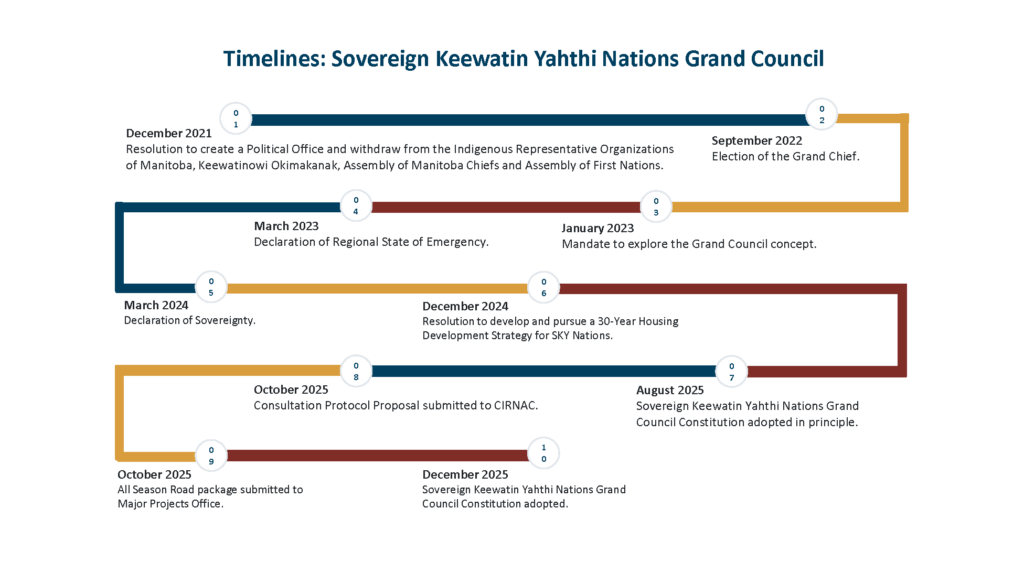
Key SKY Nations Governance, Organizational and Collaborative Milestones from 2021-2025
For generations, First Nations leadership has worked to protect Treaty rights, strengthen governance, and advance self-determination. From traditional governance systems and Treaty relationships to regional, provincial, and national advocacy organizations, each generation has contributed to the ongoing pursuit of Nationhood and self-governance.
Building upon this legacy, the Sovereign Keewatin Yahti Nations (SKY Nations) Grand Council emerged as a collective vision of its member Nations – grounded in sovereignty, unity, and the exercise of inherent and Treaty rights.
Our milestones highlight the key governance, organizational, and collaborative developments that led to the establishment of SKY Nations Grand Council.

11 Nations.
One United Voice.
Quick Links
© All Rights Reserved.